By the middle of August, some of you are asking a quiet question you haven’t said out loud yet. Has anything actually changed since June? You started God Encounters believing something. You worked through Breakthrough hoping to hear more clearly.
You picked up a daily gratitude practice. And yet the mirror looks the same. The days still feel ordinary. You’re left wondering whether growth you can’t feel yet counts as growth at all.
However, Scripture never measured growth by how quickly it could be felt.
If you’d rather start the journey now and come back to this afterwards, you can begin right here: Start with God Encounters. For everyone else, here’s why growth you can’t feel yet is still real growth. And here’s why the quiet middle of a season is exactly where it tends to happen.
Why We Expect Growth to Announce Itself
Most of us learned to measure progress the way we measure everything else. Visibly, quickly, and on a schedule we can track. Therefore, when a spiritual practice doesn’t produce a noticeable shift within a few weeks, it’s easy to conclude that nothing is actually happening. However, that conclusion says more about our impatience than about what’s true underneath the surface.
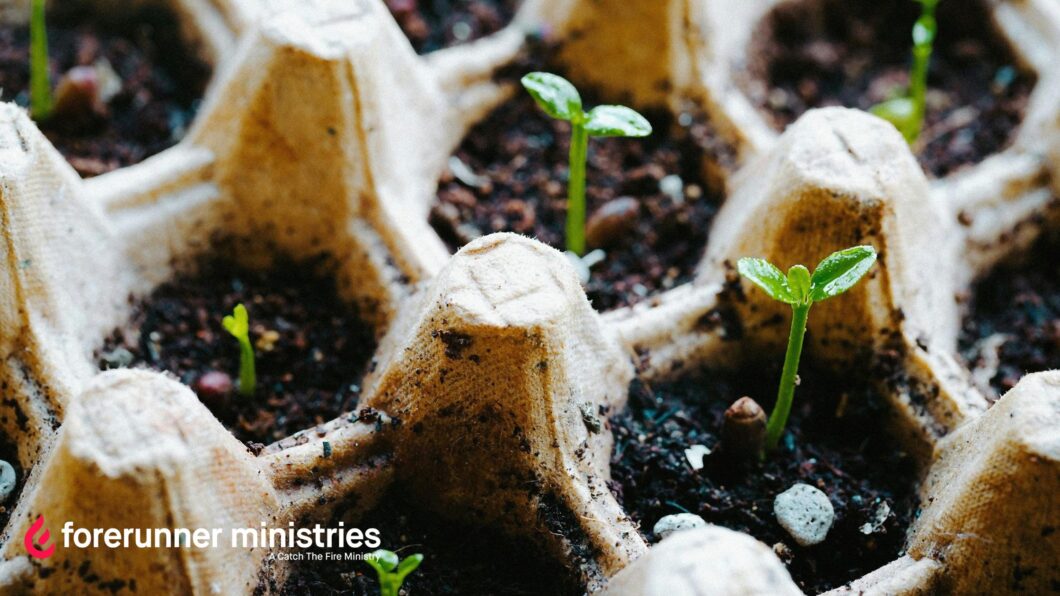
Consequently, growth you can’t feel yet gets mistaken for growth that isn’t happening. A plant doesn’t stop growing during the weeks no one sees a new leaf. Instead, the growth continues below the surface. It moves through root systems nobody’s checking, long before anything visible breaks through the soil.
This matters especially in mid-August, well into a season built around three free mini-courses. Not a single dramatic event. The absence of one obvious turning point isn’t a flaw in the design. It’s the design working exactly as intended.
The Seed Growing Secretly, Whether Anyone Notices or Not
Mark 4:26-29 describes the kingdom of God like a farmer who scatters seed. He sleeps and rises night and day while the seed sprouts and grows, and he doesn’t know how.
Notice what the parable doesn’t say. It doesn’t say the farmer’s attentiveness produced the growth, or that his understanding of the process sped it along. Instead, the seed grew on its own, following a process entirely outside the farmer’s awareness.
Rather than needing the farmer’s supervision, the ground itself produced first the stalk, then the head, then the full grain. All without a single dramatic moment the farmer could point to as the turning point.
Growth you can’t feel yet works the same way. It rarely announces itself with a single obvious marker. Instead, it accumulates quietly, underground, the same way the seed in this parable did while the farmer simply went about his ordinary nights and days. That’s how the kingdom of God works.
This same quiet accumulation shows up wherever a gift is actually growing. Those exploring the gift of prophecy often describe exactly this kind of arc. Growth that felt dramatic at first gradually settles into something steadier, not because it weakened, but because it moved past needing to announce itself.
The same is true of spiritual impartation. The deepest formation rarely happens on the timeline that would make it easiest to notice.
Still not sure you can actually hear God’s voice for yourself? You’re not the only one. Start our free 8-minute course, Breakthrough to Hearing God’s Voice. It’s free. It’s short. And it might be exactly what turns the uncertainty into recognition.
Small Beginnings Were Never a Sign You’d Failed
Zechariah 4:10 asks a pointed question: “Who dares despise the day of small things… ?” The prophet isn’t describing an ideal to strive for. Instead, he’s naming a temptation that was already present in his audience, the temptation to treat a small, unremarkable beginning as evidence that the larger work had failed.
However, the text doesn’t promise the small beginning will feel significant while it’s happening. Rather, it simply insists that small beginnings deserve respect, not dismissal. They’re beginnings of something real, not symptoms of something failing. Growth you can’t feel yet is, almost by definition, a small beginning still working itself out beneath whatever you can currently perceive.
If you’ve read our post on Hearing God in the Ordinary Days of Summer, you already know that the ordinary was never signs of God’s absence. Small beginnings work the same way. They’re not consolation prizes handed out until the real growth arrives later. They are the real growth, simply not yet at the size where it’s easy to notice.
Zechariah’s audience was rebuilding a temple that looked embarrassingly modest compared to the one it replaced. It would have been easy for them to read that modesty as failure.
Instead, the text reframes the small, unimpressive beginning as something worth rejoicing over. Not despite its size, but simply because it was real and already underway. This deserves that same reframing, rather than the quiet dismissal it usually gets.
Changed From the Inside Out, One Degree at a Time
2 Corinthians 3:18 describes believers being transformed into the same image from one degree of glory to another. Notice the pace built into that phrase. One degree at a time, not one dramatic leap.
Consequently, this is one of the clearest biblical descriptions of growth you can’t feel yet. A single degree of change is, by definition, too small to register on its own.
Instead of a single decisive moment that changes everything at once, the text describes an ongoing process. Degree by degree, each one so small it would be nearly impossible to notice in isolation. Rather, it’s only when you compare where you are now to where you started, weeks or months earlier, that the accumulated degrees become visible at all. That’s precisely why growth you can’t feel yet often only becomes recognizable in hindsight, the same way Jacob recognized what had already been true once he woke up and looked back.
This is worth sitting with for a moment. “Degree” language cuts against how most of us actually track spiritual progress. We tend to look for a before-and-after, a clear line separating who we were from who we’re becoming.
Paul’s language offers something different. Not a line, but a gradient, one so gradual that no single week will ever feel like the week everything changed. Growth you can’t feel yet is simply what that gradient looks like from the inside, before enough degrees have accumulated to notice.
Still Bearing Fruit in a Season That Looks Unremarkable
Psalm 92:12-14 says “the righteous will flourish like a palm tree, … planted in the house of the LORD.” It says they still bear fruit in old age, staying full of sap and green. Notice that this isn’t a psalm about early, visible bursts of growth. Instead, it’s describing fruit borne late, in a season that looks, from the outside, like decline rather than growth.
Our post on How to Stay Connected to God When Your Routine Falls Apart explores a closely related idea. Connection with God was never dependent on ideal, visible conditions holding steady. Growth you can’t feel yet depends on that same truth.
The fruit in this psalm doesn’t require a fresh, obviously fertile season to appear. It simply requires staying planted, the same posture whether or not anyone can currently see what’s forming underneath.
Prophetic intercession works the same way. Our post on partnering with heaven to shift earth explores this in more depth. Intercession that starts as occasional, urgent prompting often matures into a steadier, less dramatic rhythm. Not because the calling faded, but because it settled into something sustained.
Growth You Can’t Feel Yet Is Still Worth Trusting Right Now
Our post on Why a Daily Gratitude Practice Changes What You Notice already touched on this. Attentiveness changes what gets recognized, far more than it changes what’s actually present. Growth you can’t feel yet is present either way, whether or not this particular week gives you anything to point to as proof.
You don’t need a visible marker before you keep going. The seed the farmer scattered didn’t wait for his confidence before it grew. The growth already forming in you isn’t waiting for your confidence either.
Consequently, the mid-August stretch of an ordinary summer is not evidence that momentum has stalled. It’s simply the part of the process that happens underground, the same way it always has for everyone who has ever grown into anything real.
Keep showing up to the small, unremarkable practices in front of you. Scripture suggests the growth is already underway, whether or not this particular week hands you proof of it. There’s more forming in this season than it might look like from where you’re standing right now.
That’s true whether you’re near the beginning of this journey, deep in the middle of it, or unsure exactly where you stand. The growth doesn’t wait for you to locate yourself before it keeps happening.
Wherever you are in the journey, this is worth saying plainly. Growth you can’t feel yet is not a smaller category of growth. It’s the same growth, simply caught at an earlier point in the process, before it’s had the time to become visible to you or to anyone else watching, including yourself.
Ready to Keep Building on What’s Already Underway?
We’ve put together Your Summer with God, three free on-demand mini-courses designed to keep you moving with God through the summer months — no schedule, no pressure.
Step 1 — God Encounters: Hear Franklyn’s story of encountering the living God.
Step 2 — Breakthrough: Learn to hear His voice for yourself.
Step 3 — Maximize Your Gratitude: Build the daily foundation that sustains it all.
And keep watching this space — something new is quietly taking shape for September 2026